
Watching the Film “Adaptation” Through the Lens of Body Dysmorphia — 7 Takeaways

“I’m old. I’m fat. I’m bald. My toenails have turned strange. I am old. I am… I have nothing. She’ll think I’m an idiot. Why couldn’t I stay on that diet? She’ll pretend not to be disappointed, but I’ll see that look, that look… God, I’m repulsive. But as repulsive as I think? My Body Dysmorphic Disorder confuses everything. I mean, I know people call me Fatty behind my back. Or Fatso. Or, facetiously, Slim. But I also realise this is my own perverted form of self-aggrandisement, that no one talks about me at all. What possible interest is an old, bald, fat man to anyone?”
Relax. I’m not breaching confidentiality or having a nervous breakdown. These are the opening lines of Adaptation (2002).
This piece is in two parts.
The first is about Body Dysmorphic Disorder told through the lens of CBT: what maintains it, why reassurance rarely helps, and why the mirror is never actually the problem.
2. The second part is the analysis of seven sentences, because I think they do something rare: they give us the possibility to discuss psychological processes in depth without breaching confidentiality.
Introduction (Spoiler Alert: not too much though).
Directed by Spike Jonze and written by Charlie Kaufman, Adaptation is one of the most unconventional films I’ve ever watched. On the surface, it follows Charlie Kaufman (played brilliantly by Nicolas Cage), a screenwriter struggling to adapt Susan Orlean’s non-fiction book The Orchid Thief into a film. Running parallel to his story is Susan Orlean (Meryl Streep), the journalist who becomes fascinated by the eccentric orchid hunter John Laroche (Chris Cooper), whose obsession with the elusive ghost orchid gradually evolves into a meditation on obsession itself.
Adding another layer of complexity is Donald Kaufman — Charlie’s fictional twin brother, also played by Nicolas Cage. Donald is everything Charlie is not: optimistic, emotionally resilient, socially confident, and blissfully free from the relentless self-analysis that consumes Charlie. As the film unfolds, the brothers begin to feel less like two separate characters and more like two contrasting ways of moving through life — one governed by self-consciousness and doubt, the other by curiosity, resilience, and action.
1. Charlie’s Opening Monologue
The opening monologue immediately caught my attention because it captures something that psychological textbooks often struggle to convey: what it actually feels like to inhabit a mind that has become its own relentless observer. What appears, at first, to be a sequence of self-deprecating jokes gradually reveals itself as something far more sophisticated. Charlie is caught inside a recursive loop in which every attempt to examine his own thoughts becomes another object of examination.
This recursive quality is what makes the monologue so psychologically accurate. Charlie doesn’t merely conclude that he is unattractive, he notices the conclusion, questions whether it is true, recognises that his perception is distorted, and then immediately turns that insight into yet another reason to criticise himself. His awareness doesn’t interrupt the cycle; it becomes absorbed into it. Self-awareness, which ordinarily allows us to step back from our thoughts, has itself become entangled in the disorder. The very faculty that might have restored perspective has been recruited into maintaining the problem.
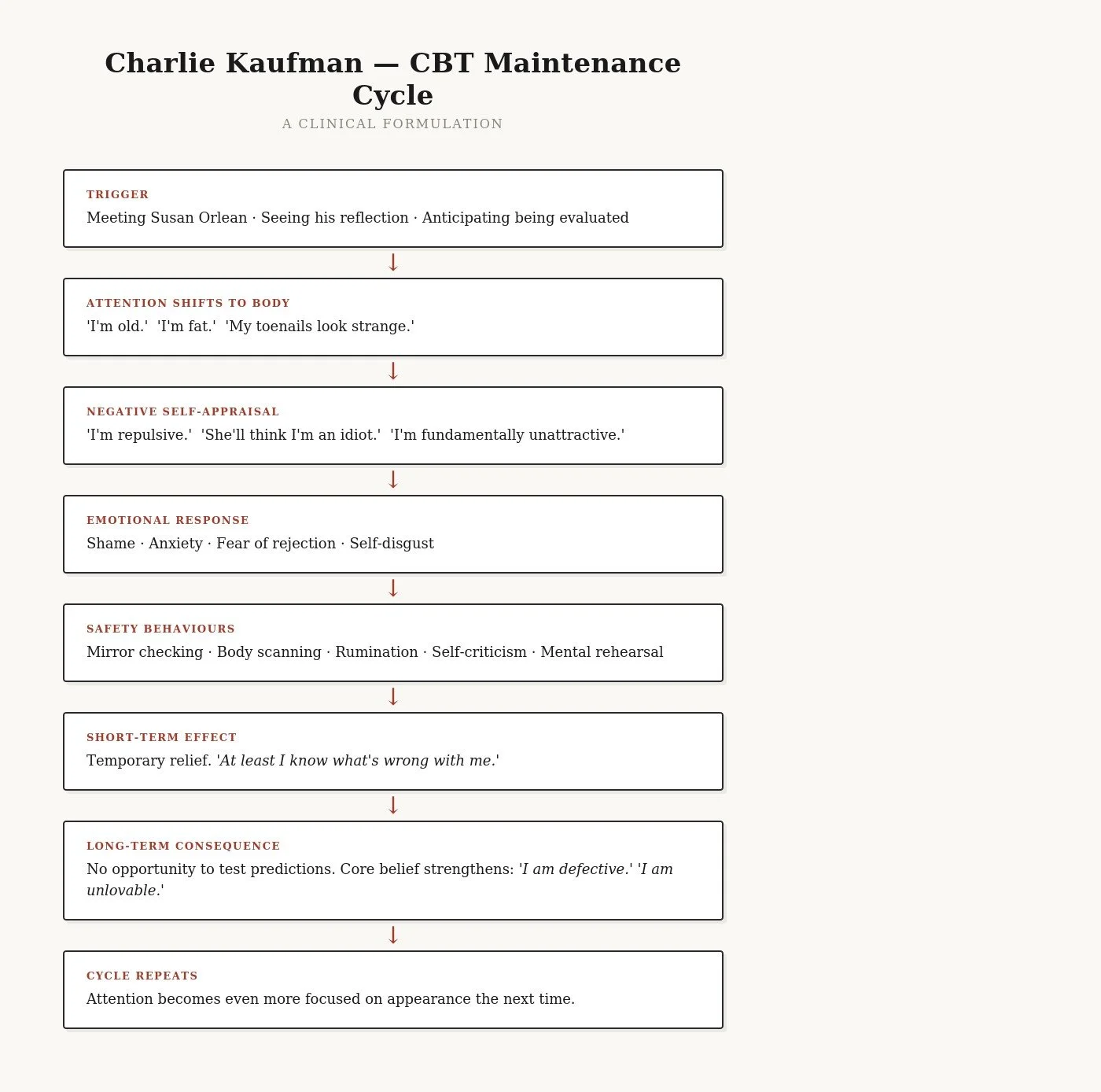
Basically, something happens: you catch your reflection, you’re about to be judged or evaluated, you meet someone new. In that moment, your attention snaps straight to your body. Not your thoughts, not the situation, your body. “I look old.” “I look fat.” “Something’s off about me.”
That’s the first trap. Once your attention is locked onto how you look, your brain starts treating that focus as evidence. You’re not just noticing your body, you’re building a case against yourself. “I’m repulsive.” “They’re going to think I’m ridiculous.” “There’s something fundamentally wrong with me.”
That belief doesn’t stay abstract, it produces real feelings. Shame. Anxiety. The fear that someone’s about to reject you. A kind of disgust with yourself that feels less like an opinion and more like a fact.
And when you feel that bad, you do something to cope. You check the mirror again. You scan your body for flaws. You replay the moment in your head. You criticise yourself before anyone else can. You rehearse what you’ll say or how you’ll stand next time, trying to control the outcome in advance.
Here’s the part that’s easy to miss. those coping behaviours work, a little, straight away. The anxiety drops. You feel like you’re doing something. There’s even a strange comfort in it, “at least I know what’s wrong with me” feels more bearable than uncertainty.
But that relief is the trap closing. Because you never actually put your fear to the test. You never let the moment happen without the mirror checking or the rehearsal or the self criticism, so you never get to find out that people mostly weren’t judging you the way you thought. Instead, your brain logs it as “the safety behaviour saved me”, which quietly confirms the original belief: I am defective. I am unlovable.
The way out isn’t “think more positively.” It’s noticing the moment your attention locks onto your body, and instead of doing the checking, scanning or rehearsing, letting the anxious moment pass without the safety behaviour, so you actually get the chance to learn that the feared outcome usually doesn’t happen.
One of the smallest moments in the scene illustrates this beautifully. Charlie catches his reflection in the mirror, immediately looks away, and then glances back a second time. It lasts only a few seconds, yet it captures a behaviour frequently observed in Body Dysmorphic Disorder: compulsive checking. The checking itself is rarely about discovering what one looks like. The individual already possesses a deeply ingrained emotional conviction. Instead, each glance represents another attempt to obtain reassurance from the external world that the internal experience is mistaken. Unfortunately, no reflection can answer the question that is actually being asked. Mirrors can reflect appearance, but they cannot resolve uncertainty about one’s worth, lovability, or acceptability.
Perhaps the most remarkable line in the monologue comes when Charlie says, “My Body Dysmorphic Disorder confuses everything.” That single sentence reveals an aspect of psychological suffering that is often overlooked. Charlie possesses insight. He recognises that his perception cannot be entirely trusted. Yet the emotional experience remains completely convincing. This distinction between intellectual understanding and emotional conviction is central to many forms of psychological distress. The rational mind may recognise that a belief is distorted, while the nervous system continues to respond as though it were unquestionably true. Awareness, therefore, does not necessarily dissolve suffering. In some cases, it merely adds another layer to it, because now the individual not only experiences the distress but also becomes painfully aware that they are experiencing it.
What makes this opening especially compelling, however, is that Charlie’s mind is not behaving irrationally in the sense of being random. Every thought follows a logic. If he identifies every flaw before anyone else notices it, perhaps rejection can be anticipated. If he criticises himself first, perhaps the criticism of others will hurt less. If he continually monitors his appearance, perhaps he will eventually discover the adjustment that finally earns acceptance. His mind is attempting to produce safety. The difficulty lies in the fact that strategies originally organised around protection gradually become sources of chronic distress. They continue operating long after the circumstances that may once have required them have disappeared.
The monologue reaches its deepest psychological moment with Charlie’s observation that believing other people constantly judge him may itself be “a perverted form of self-aggrandisement.” I found this extraordinarily insightful because it exposes one of the paradoxes of self-consciousness. The anxious mind often imagines itself as insignificant while simultaneously assuming that everyone else is thinking about it. Even self-rejection can preserve the illusion that one occupies the centre of other people’s attention. Charlie recognises this paradox intellectually, yet recognising it provides no relief. The insight becomes simply another object for analysis.
By the time he asks, “What possible interest is an old, bald, fat man to anyone?” the conversation has shifted. The body remains the focus of attention, yet the emotional question has become much broader. Appearance has become the language through which concerns about belonging, significance, rejection, and worth are expressed. The body offers something concrete that the mind can endlessly inspect, measure, and attempt to improve. Questions concerning whether one matters, whether one deserves love, or whether one’s existence carries value are infinitely more difficult to confront directly. The body therefore becomes the surface upon which those deeper anxieties are projected.
My 7 gems
1. We often become attached to the struggle as much as the goal
“Laroche loved orchids… he loved the difficulty and fatality of getting them almost as much as he loved the orchids.”
This may be the most psychologically profound observation in the entire film.
At first glance, it appears that Laroche is obsessed with orchids. Yet as Susan Orlean gradually comes to understand him, something subtler emerges. The orchid itself almost becomes secondary. What truly animates him is the pursuit — the uncertainty, the rarity, the possibility of failure, and the satisfaction of chasing something that few people are willing to chase.
Psychologically, this isn’t unusual at all.
Many of us believe we’re pursuing a destination when, in reality, we’ve become organised around the pursuit itself. Careers, relationships, academic achievements, spiritual journeys — even happiness — can become structures that give life coherence. The struggle provides rhythm, identity, and purpose. Reaching the goal sometimes creates an unexpected emptiness because the very thing that organised our lives has disappeared.
….Perhaps this is why some people unconsciously create new mountains the moment they reach the summit of the previous one.
2. We rarely pursue objects; we pursue what they represent
Laroche believes he is chasing orchids.
Psychologically, he is pursuing significance.
Objects rarely possess the emotional value we attribute to them. Instead, they become containers for deeper psychological needs. The orchid represents mastery, uniqueness, freedom, beauty, and perhaps most importantly, the feeling of being completely absorbed in something larger than oneself.
This helps explain why two people can encounter exactly the same object and experience entirely different emotions. One sees a flower. Another sees purpose.
Much of human motivation works this way. We rarely desire things in isolation. We desire what we imagine those things will allow us to feel.
3. Humans naturally romanticise difficulty
The ghost orchid isn’t valuable simply because it is beautiful.
It becomes beautiful because it is elusive.
Psychologists have long recognised that scarcity changes perception. The less available something becomes, the more desirable it often appears. Difficulty transforms ordinary pursuits into meaningful quests. Effort changes the emotional value of the reward.
But there is another layer.
Difficulty also changes how we see ourselves.
When we willingly endure discomfort for something, we begin to feel that our lives possess direction. Sacrifice creates meaning. The harder the climb, the more convinced we become that the summit must be extraordinary.
4. Purpose becomes identity
One of the most heartbreaking lines in the film comes from the young boy who says:
“I don’t think my life is worth living if I can’t do this.”
At first, the statement seems dramatic. Then you realise how common it is. Replace turtles with writing. Or success. Or medicine. Or being a good parent. Or changing the world….
The sentence still works.
Purpose gives life direction, but it also carries a hidden risk. Over time, the activity can become inseparable from identity. Success no longer feels satisfying — it becomes necessary. Failure no longer disappoints — it threatens the very foundation upon which the self has been built.
The pursuit itself isn’t the problem.
The problem begins when our worth depends entirely upon its outcome.
5. Learning the rules is different from creating something new
One of my favourite lines in the screenplay is Charlie’s observation that:
“Writing is a journey into the unknown, not building a model airplane.”
Technique has immense value.
It teaches structure, discipline, and craftsmanship.
But technique alone cannot produce originality.
We see this clearly in football. Ousmane Dembélé, Ballon d’Or winner, has technique that is close to flawless, but watch him closely and you’ll notice he tends to repeat the same move: the same cut inside, the same feint, executed to near perfection. It works, often brilliantly, but it’s technique refined to its ceiling, not reinvented.

Maradona was different. He didn’t just execute moves better than everyone else, he produced moments that had no precedent, that weren’t in the coaching manual because no one had done them before him. That’s the difference between mastering a known vocabulary and inventing a new one.
Originality begins where certainty ends.
Every genuinely creative act requires stepping beyond what is already known. Rules can explain what has worked before. They cannot fully explain what has never existed.
This extends well beyond writing, or football.
Whether we are building a career, raising children, starting a business, or simply trying to become more ourselves, there eventually comes a point where following maps is no longer enough.
The next step always involves entering territory that no one can navigate for us.
6. Analysis eventually becomes paralysis
Charlie possesses extraordinary insight.
He understands stories, people, himself.
Yet he struggles to write.
Donald’s screenplay is objectively ridiculous.
Yet Donald finishes it.
This contrast illustrates one of psychology’s enduring paradoxes. Intelligence does not necessarily produce action. In fact, excessive analysis often expands uncertainty until every possible decision appears flawed.
There comes a point where thinking no longer serves progress.
It begins protecting us from the discomfort of acting. Action exposes us to failure. Analysis keeps failure hypothetical.
7. Humility accelerates learning
Donald is frequently dismissed as naive. Yet he possesses one quality Charlie lacks. He isn’t afraid of not knowing.
He asks questions, accepts correction and apologises without defensiveness.
This may be one of the film’s most overlooked psychological insights.
Learning depends less on intelligence than on our relationship with uncertainty!
People who need to appear competent often stop asking questions long before they stop needing answers. Their identity becomes invested in already knowing.
Donald has no such burden.
