
The Dark Humour of Carl Jung
One of the things I have always appreciated about Carl Jung is that, despite the reputation he acquired as a profound and often difficult thinker, he possessed a remarkably dry sense of humour. Reading him closely, one eventually notices that some of his most penetrating psychological observations are hidden inside what appear to be throwaway remarks. They are witty, occasionally sarcastic, and sometimes almost mischievous.
Unlike many psychologists who attempted to simplify the mind into neat theories, Jung seemed almost suspicious of certainty. He wrote as someone who believed that the psyche is too vast and too contradictory to be reduced to a single system or conclusion. Perhaps that is why humour came so naturally to him. I think humour has a peculiar ability to expose the limits of our certainty.
One of his most famous remarks illustrates this perfectly: “Thank God I’m Jung and not a Jungian.”
Jung had witnessed how easily ideas become ideologies. Once a body of knowledge begins attracting devoted followers, something curious often happens. Exploration gives way to doctrine. Questions become answers. Intellectual curiosity slowly transforms into intellectual certainty.
History offers countless examples of this tendency. One is tempted to imagine the Buddha saying, “Thank goodness I’m not a Buddhist,” or Jesus remarking, “Thank goodness I’m not a Christian.” Whether they ever would have said such things is beside the point. The point is psychological. Living insights have a curious tendency to become fixed identities. What begins as an invitation to inquire slowly hardens into a system of beliefs, complete with labels, boundaries and certainties.
Perhaps this is why I am cautious about describing myself by any particular tradition. If, during one of my sessions, you hear me say that I am a Buddhist or a Christian, it is usually for the sake of communication rather than conviction. In one sense, I am both; in another, I am neither. The same applies to my profession. I am not a therapist. I am a person who works as a therapist. There is an important difference. The moment we mistake a role, a belief or a title for who we are, we begin to identify with the label rather than the living person behind it. Labels are useful for communication, but they become limiting when we confuse them with our identity.
Jung resisted that temptation throughout his life.
Another of his observations has remained with me for years: “Show me a sane man and I will cure him.”
When I was younger, I spent a great deal of energy trying to appear emotionally composed. Like many people entering psychology, I imagined that maturity meant overcoming anxiety, anger or insecurity. These feelings appeared to be obstacles standing between myself and some future version of psychological health.
Jung proposed something rather different.
He suggested that what we call normality is often little more than successful adaptation. Beneath the surface, every individual carries conflicts, contradictions and impulses they would rather not acknowledge. The task is not to eliminate them but to become conscious of them. In Jungian language (and EMDR), this is the process of integration.
This reminds me of another remark, this time from the ninth-century Chinese Zen master Linji, who advised his students: “If you meet the Buddha, kill him.” The statement was never intended literally. Rather, it was a warning against psychological authority. The moment we cling to an image of the Buddha — or indeed any teacher, doctrine or ideal — we risk substituting direct understanding with imitation. In that sense, Linji’s words echo Jung’s suspicion of rigid systems and fixed identities. Both recognised how easily living insight becomes something we merely believe in rather than something we continue to discover for ourselves.
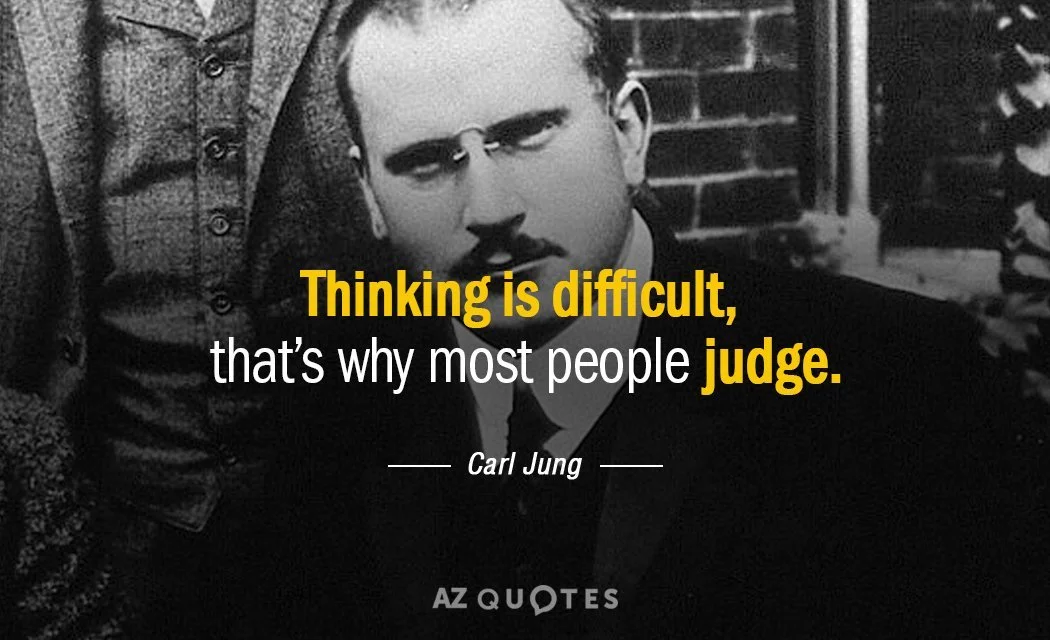
There is another sentence of Jung’s that I often find myself recalling during difficult conversations: “Thinking is difficult. That is why most people judge.”
It is an observation that becomes increasingly convincing the longer one works with people. Judgement requires remarkably little effort. Reflection demands much more. It asks us to tolerate uncertainty and, perhaps more importantly, to examine our own contribution to the situations we find ourselves in.
One of Jung’s greatest contributions to psychology was his understanding of projection. The qualities we condemn most intensely in others are sometimes qualities that remain unresolved within ourselves. This does not mean every criticism is merely projection, nor does it excuse harmful behaviour. Rather, it invites us to pause before rushing to certainty. Occasionally, the strongest emotional reactions tell us more about ourselves than about the person standing in front of us.
Perhaps the most cutting of Jung’s observations concerns spirituality. He wrote that people “will practise Indian yoga and all its exercises, observe a strict regimen or diet, learn theosophy by heart, or mechanically repeat mystic texts from the literature of the whole world — all because they cannot get on with themselves.”
At first glance, the remark can sound dismissive of spiritual traditions. I do not think that was Jung’s intention. Rather, he seems to be examining the psychological motive behind the search itself. In this respect, his thinking bears some resemblance to that of Jiddu Krishnamurti, who argued that the mind constantly invents methods because it hopes to become something other than what it is. It imagines that, through discipline, technique or spiritual practice, fear can gradually become fearlessness, loneliness can become fulfilment, and confusion can become clarity. Yet, for Krishnamurti, the very movement of trying to become something else is already part of the conflict.
Although Jung approached the question from a psychological rather than philosophical perspective, he appears to arrive at a similar concern. One may spend years collecting spiritual experiences, mastering meditation techniques or studying sacred texts while quietly avoiding the far more demanding task of understanding oneself. In such cases, spirituality becomes not a path towards self-knowledge but a subtle form of escape. The practices themselves are not the problem; rather, the individual may expect them to resolve an inner conflict whose origins can only be understood through honest psychological inquiry.
As I reflect on Jung’s words today, I am reminded of Jon Kabat-Zinn’s simple observation: “Wherever you go, there you are.” It captures something that Jung understood decades earlier. No philosophy, no technique and no spiritual tradition can substitute for the difficult work of becoming acquainted with one’s own mind.
Perhaps this is why Jung’s humour still feels so relevant: we spend extraordinary amounts of time searching for ourselves everywhere except the one place we cannot escape.
Ourselves.
