
Can an 800-year-old story teach you one of the most powerful secrets of the mind and tame your anxiety?
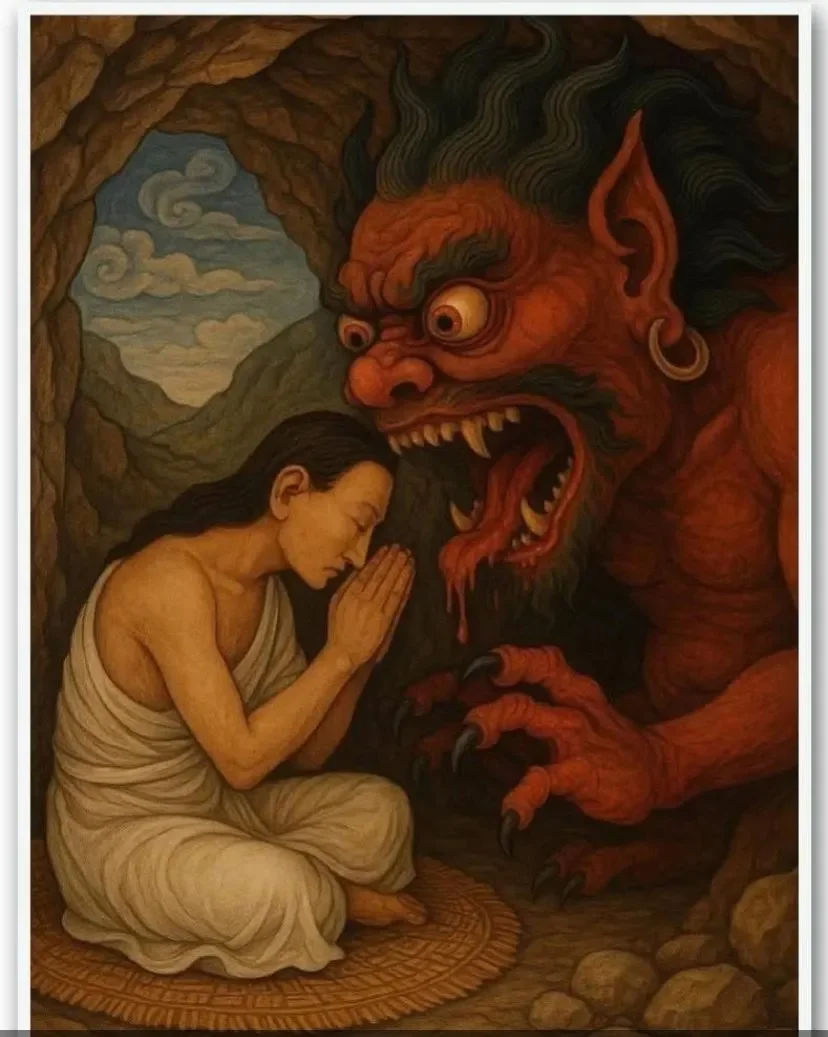
I love this story. I return to it often.
Because it reveals something important about the mind and about spiritual practice.
The story is a tool. A tool for emotional freedom. A tool for facing fear and unwanted thoughts. Why? Becauase what we call a “demon” is rarely evil. Most of the time, it’s just energy , emotion that hasn’t found a healthy way to express itself yet.
If you’re a therapist, I hope this story gives you something useful for your practice.
And if you’re a client, I hope it helps you make peace with a few of your own demons.
Here is the story:
“When Milarepa was deep in his meditation practice, he lived alone in a small rocky cave. One day, after wandering in the mountains gathering food, he came back and found his cave filled with demons. They were horrible, ugly, frightening creatures — squatting everywhere, growling, laughing at him.
At first, Milarepa tried to teach them the Dharma. He sat calmly and spoke of impermanence, of emptiness, of compassion. But the demons only laughed louder, mocking him.
Next, Milarepa grew angry. He shouted at them, demanded they leave. He tried to scare them away. But the more he fought, the more solid and powerful the demons became, as if they were feeding off his fear and anger.
Realising his efforts were useless, Milarepa paused. He remembered the true essence of his practice — not fighting with appearances, not clinging to fear or pride. So he softened. He sat down and said gently, “I accept you. You may stay if you wish. This cave is big enough for all of us.” Hearing this, many of the demons disappeared instantly, like mist touched by the morning sun.
But one demon remained. The biggest one, the most terrifying, its mouth open wide, dripping with blood. It seemed it would devour him whole.
Milarepa felt a deep surge of fear rise up — but he did not run. Instead, he walked straight toward the demon. He bowed low and placed his head inside the demon’s mouth, offering himself completely. “If you wish to eat me,” he said, “then eat me.”
In that moment of total surrender, without a trace of resistance or fear, the final demon vanished into emptiness .”
The best seeing is the way of “nonseeing” the radiance of the mind itself. The best prize is what cannot be looked for the priceless treasure of the mind itself. When one comes to the essence of being, The shining wisdom of reality Illumines all like the cloudless sky.
Rest in a natural way like a small child. Rest like an ocean without waves. Rest within clarity like a candle flame. Rest without self-concerns like a human corpse. Rest unmoving like a mountain.
Milarepa
Whether we have sat on a meditation cushion or in a therapist’s chair, I think we can distinguish three distinct psychological stances:
1. Intellectualising
“At first, Milarepa tried to teach them the Dharma.”
Milarepa’s first response is to explain. He sits calmly and speaks of impermanence, of emptiness, of compassion — reaching for wisdom and reason to dissolve what frightens him. It doesn’t work. The demons only laugh louder.
This reflects a tendency many of us fall into: managing distress through reasoning rather than direct emotional engagement — trying to think our way out of fear instead of actually feeling it. The demons laughing represents life mocking our intellectual spirituality. We can understand a concept perfectly and still feel its opposite in our bones. Insight, on its own, rarely dissolves what is unresolved.
2. Fighting — the fight-or-flight response
“He shouted at them, demanded they leave.”
When explanation fails, Milarepa’s next instinct is control. He raises his voice, tries to force the demons out. It is the oldest response we have: anger as a defence, aggression as a shield.
But the story is unambiguous about what happens next — the more he fights, the more solid and powerful the demons become, as if they are feeding on his fear and anger. This captures the instinctive urge to control or eliminate the source of fear through force, which, as the story shows, often backfires and intensifies the very thing being resisted. It is a pattern that shows up again and again in how we handle anxiety: what we resist tends to persist, and often grows louder for the resisting.
3. Acceptance
“So he softened. He sat down and said gently, ‘I accept you. You may stay if you wish.’”
And then, Milarepa stops fighting and stops explaining. He softens, and invites the demons to stay.
This marks the turning point where resistance gives way to allowing — a stance closely mirrored in modern therapeutic approaches such as Acceptance and Commitment Therapy (ACT), and echoed too in Carl Rogers’ idea of unconditional positive regard: that real change tends to happen not through force or judgement, but through being fully met and accepted as we are. The moment Milarepa stops treating the demons as enemies, most of them simply vanish.
