
CBT or EMDR? Looking at Trauma Through the Lens of Modern Physics
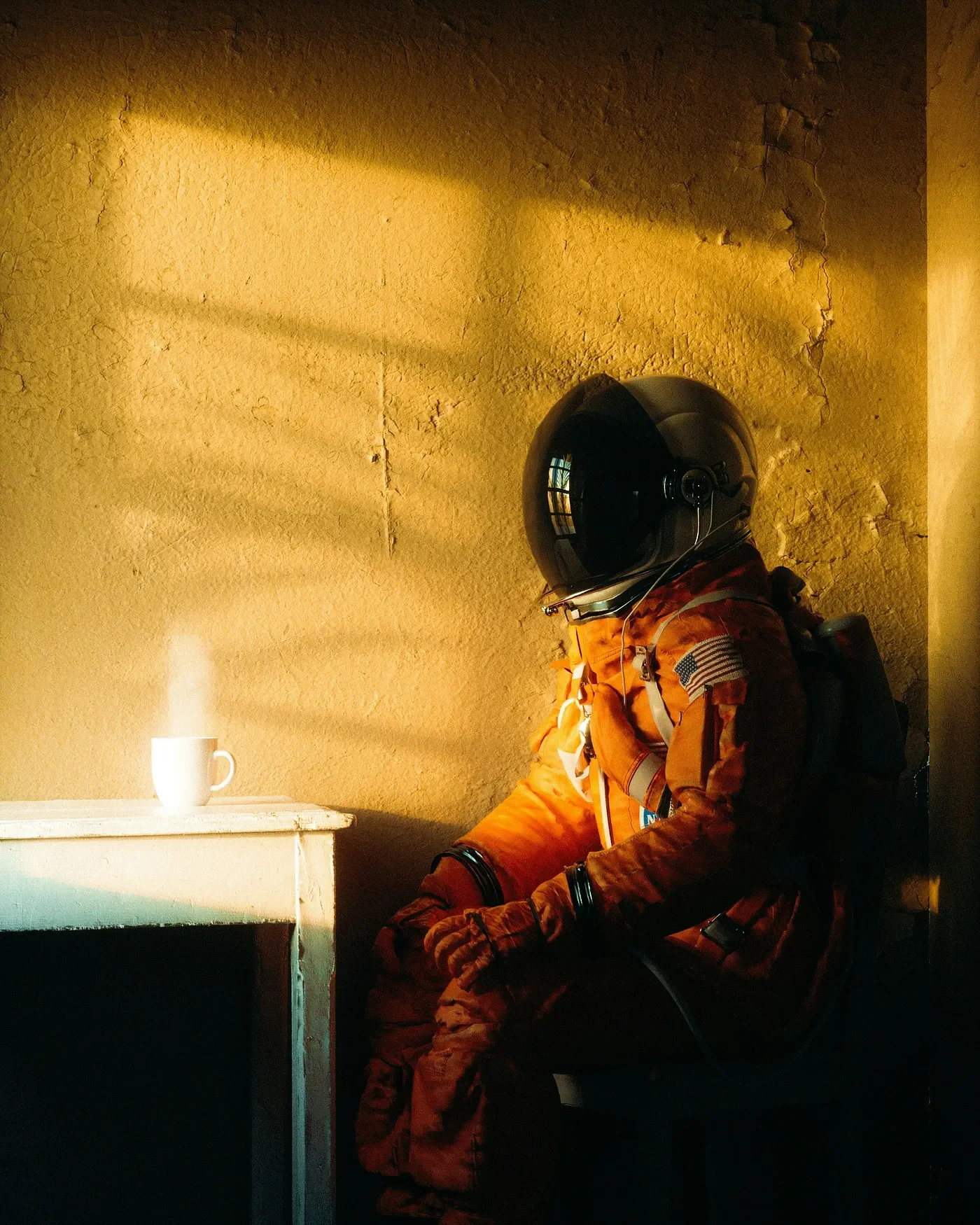
Photo by Cash Macanaya on Unsplash
I have spent a great many quiet moments in my consulting room observing a client's expression shift mid-sentence — the moment at which they stop describing an event and begin, instead, to relive it. This transition happens with striking speed, and it was one of the observations that first drew me toward thinking about time itself, rather than memory alone.
Classical physics long treated time and space as fixed backdrops — the stage upon which life and matter unfolded, unmoving and universal. Einstein's work dissolved that distinction, folding the two into a single continuum. More recently, physicists such as Carlo Rovelli, an Italian theoretical physicist known for his contributions to quantum gravity, have gone further still, proposing that time may be more fundamental than space. In his account, space is not something we move through, but a pattern that emerges from relationships between events. I find this framework unexpectedly clarifying when considering the clients before me — as though space itself were something constructed from what has happened to a person, rather than a fixed container they simply occupy.
As Rovelli writes in The Order of Time, the world is not a collection of things but a collection of events.
I find myself returning often to what this might mean for trauma. We are, before much else, temporal beings. Thought moves constantly forward and backward across time. Memory is not confined to the past — it resides in muscle, in breath, in the register we adopt when speaking to ourselves at three in the morning. This is most visible, clinically, in clients who have experienced overwhelming events: they cease to inhabit the present and instead become caught within a loop. The past continually reasserts itself. The future contracts. And their internal space — the capacity to think, imagine, and simply be — collapses in tandem. I tend to observe this collapse in the body well before it is articulated in words. If space is indeed contingent upon time, as Rovelli suggests, then our felt sense of internal openness depends on the safety of our relationship to time. When time feels dangerous, everything narrows. When time feels fractured, experience becomes chaotic, or numb.
Consider a child once bitten by a dog who continues to flinch at the sound of barking years later, even in the presence of a small and gentle animal. The body has not yet registered present safety. Or consider Harry Potter, waking from nightmares within the safety of Hogwarts, long after Voldemort's defeat. The danger has passed, yet his nervous system has not received the update. I return to this image often in sessions, as clients tend to recognise it immediately.
Julian Barbour, a British physicist who has spent several decades questioning whether time exists at all, advances an even more radical position. In The End of Time, he argues that time itself may be illusory — that the universe consists instead of countless static "Nows," each complete and self-contained, and that our experience of time passing is merely the brain's stitching together of these still frames, not unlike leafing through an old photograph album. I recall, on first encountering this idea, sitting with it for several days, turning it over, wondering whether it might account for something I had long struggled to articulate clinically.
Barbour describes the sensation of time flowing as, in essence, a function of memory — a reflection of how the brain operates, rather than an objective feature of reality.
This challenges an assumption we rarely question — that we move through time at all. Yet if Barbour is correct, it opens an alternative account of suffering: perhaps deep distress is not a matter of time moving too quickly, too slowly, or looping without resolution, but rather of being lodged within a single, unbearable Now. This reframing altered, in a meaningful way, how I listen to clients.
Return to the same child bitten by the dog, but now imagine them freezing rather than flinching — the body no longer responding to the present moment at all, but instead to a frozen memory that remains vivid and unaltered. They are not recalling the event. Some part of them remains within it. Or Harry Potter once more — years after the war's end, gripped by a nightmare that returns him to the battlefield. He understands, intellectually, that he is safe. The world has moved on. His body has not. A portion of him continues to inhabit the pain, within a Now that never faded, replaying as though nothing had changed.
Trauma, understood this way, is not merely a disruption of emotional regulation but a form of temporal confinement. The self ceases to move. Time ceases to flow. What remains is the past, disguised as the present.
The core distinction, as I understand it:
Rovelli holds that time is primary, and that space emerges from a network of events unfolding across it.
Barbour proposes the inverse — that only space, or rather a series of disconnected "nows," exists, and that the brain is responsible for stringing these together into the appearance of motion.
If Rovelli's account holds, our experience of the present is not passive but actively constructed by the nervous system. When regulated, time flows as expected. Under distress, that flow is disrupted.
Trauma, accordingly, bends time backward. The past intrudes upon the present because the brain does not encode traumatic memory as it does ordinary memory. Such memories remain vivid, sensory, and unprocessed. The amygdala remains active while the hippocampus — responsible for temporally locating an event — is often impaired. When a trigger arises, the body responds as though the event were occurring in the present, rather than having occurred previously.
I encounter versions of this regularly in clinical practice:
I know it's over, but it still feels like I'm right back there. This captures the dissonance between intellectual understanding and embodied experience.
Every time I hear a loud voice, I freeze, like I'm a child again. Here, a present-day trigger bypasses rational appraisal, reactivating sensory and emotional memory directly.
It's like watching it happen all over again, and I can't stop it. This is not recollection but re-experiencing.
We do not remember trauma; we relive it. I have come to regard this as one of the more important observations I offer clients.
Extending Barbour's model into psychological terms yields a different picture. Suffering may not consist in time accelerating, decelerating, or looping, but in time ceasing altogether. Experience stops flowing. The individual becomes lodged within a single, unchanging emotional configuration while the world around them continues to move. Trauma, on this account, freezes the Now. It is not that the past continually returns, but that the traumatic moment never concluded. It persists, vivid and charged, much like a photograph too distressing to view yet impossible to discard. Clients describe this in comparably stark terms: I don't remember it — I live it, over and over. Or: it's like I'm stuck inside a scene that won't let me out — not metaphorical, but closer to a description of internal geography. The mind constructs a space, and part of the self remains confined within it. Or: I can feel the same fear in my chest, the same smell, the same silence just before it happened. Nothing fades. It remains suspended, awaiting a release that does not arrive.
This is not remembrance but residence. Trauma is not an event that occurred once, but a process that continues to occur, precisely because the body has not yet located an exit from that particular temporal frame.
The trauma did not simply happen. It continues to happen. I invoke this phrase often enough that it has become something of a personal shorthand.
When precedes where
Beyond Rovelli and Barbour, theorists of emergent spacetime propose something more radical still: that space itself may not be fundamental. What we perceive as location or boundary may instead be the surface expression of deeper structures — information, entanglement, causality. Physicist Fotini Markopoulou, recognised for her work on quantum gravity and the foundations of spacetime, envisions a universe in which causal relationships precede space — one in which "when" and "why" carry greater significance than "where." What matters, in this account, is not the geometry of things but the logic connecting one moment to the next. This is the framework I find myself drawing upon most frequently in clinical practice.
Return once more to the child bitten by the dog — now imagine them flinching in an entirely unfamiliar location, far removed from where the bite occurred. The trigger was never truly bound to the street or the sound itself, but to what that sound signified. The fear is not attached to geography; it is attached to helplessness, to the underlying why.
Harry Potter, again, safe within Hogwarts, the war concluded, the room unchanged — yet the causal imprint of what transpired, the betrayal, the loss, persists. The danger was never a matter of location. It is the unresolved why that has yet to be settled.
Understood in this light, the psyche may not be tethered to space at all, but shaped instead by relational time — by sequences of meaning, emotion, and memory. We do not simply exist somewhere; we are situated within our past, within those we have loved or feared, within the moments that formed us.
Clients frequently articulate this without recognising it as such: I don't feel safe anywhere, unless I'm with someone who understands me. Safety here is unrelated to physical surroundings; it concerns relational presence. Or: a smell or word can return me to a place I haven't considered in years, as though I were instantly there again. This is not spatial travel but causal entanglement — a minor sensory fragment reactivating an entire emotional scene. Or: I can't explain it, but I always feel on edge in that house, even though nothing occurred there — it's simply where everything changed. The location is charged not by what occurred within it, but by what it came to signify.
This is what I observe consistently in practice: a person's sense of "here" frequently governed by "then." The psyche does not orient itself through spatial coordinates, but through narrative and causal threads.
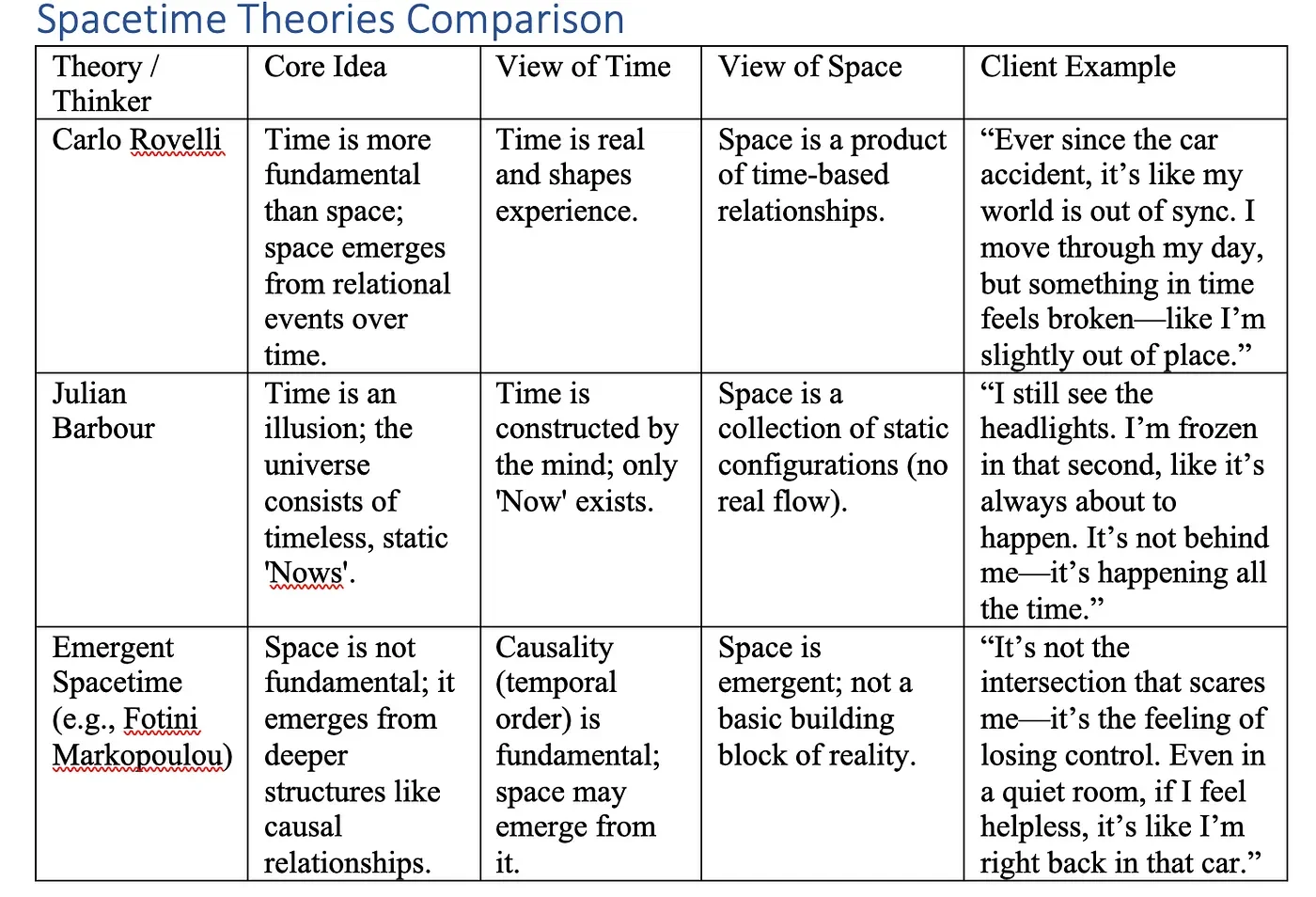
Spacetime Theories Comparison
CBT or EMDR — how I choose, through the lens of time
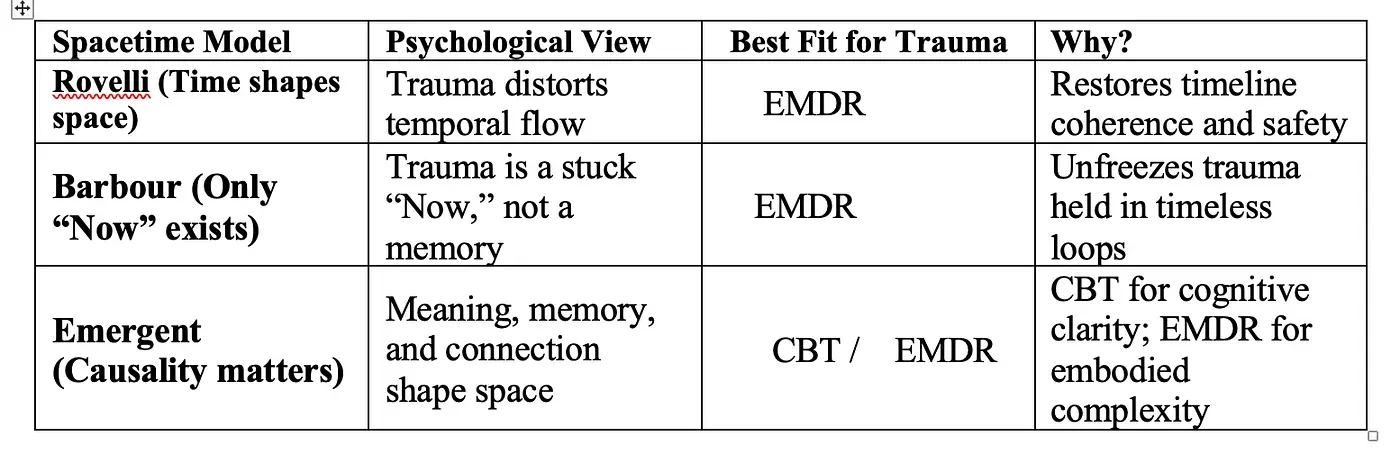
Weighing each of these three models against the two therapeutic modalities, as I apply them in practice:
Rovelli's time-primary framework aligns most closely with EMDR, in my clinical experience. EMDR engages directly with the flow of time — past, present, and future — facilitating the integration of unprocessed memory through bilateral stimulation. Its aim is to restore a sense that the event has genuinely concluded, rather than persisting indefinitely. If temporal flow is indeed what becomes disrupted in trauma, EMDR's function is essentially one of reweaving that continuity.
Barbour's frozen-Now model likewise points toward EMDR over CBT. If trauma is more accurately understood as an unresolved "Now" rather than a memory being revisited, EMDR's non-verbal, memory-based methodology is better positioned to address it. CBT relies more heavily on linear cognitive restructuring, which presupposes sufficient intact sequencing and logic to permit reframing — capacities that may not yet be accessible if a client remains trapped within a temporal loop.
Markopoulou's causal, relational model lends itself to either modality, depending on the individual client. CBT is well suited to instances where trauma is meaning-based and cognitively accessible — assisting a client in examining why a given event affected them so profoundly, and what narrative they continue to inhabit. EMDR is similarly applicable, particularly with complex relational injuries such as shame or abandonment, where it can process entangled memory and support the reorganisation of the underlying causal narrative.
Where this leaves me
EMDR tends to be the more versatile modality across all three frameworks, particularly where trauma is somatically held or resistant to rational engagement. CBT performs best where trauma remains cognitively accessible — where a client is able to identify and work directly with the beliefs and causal narratives sustaining their distress. In practice, I rarely select one modality over the other in isolation; I am generally attending to which temporal frame the person before me already inhabits, and following that lead accordingly.
